
Guest editorial by Cat Phipps from Southampton Animal Action:
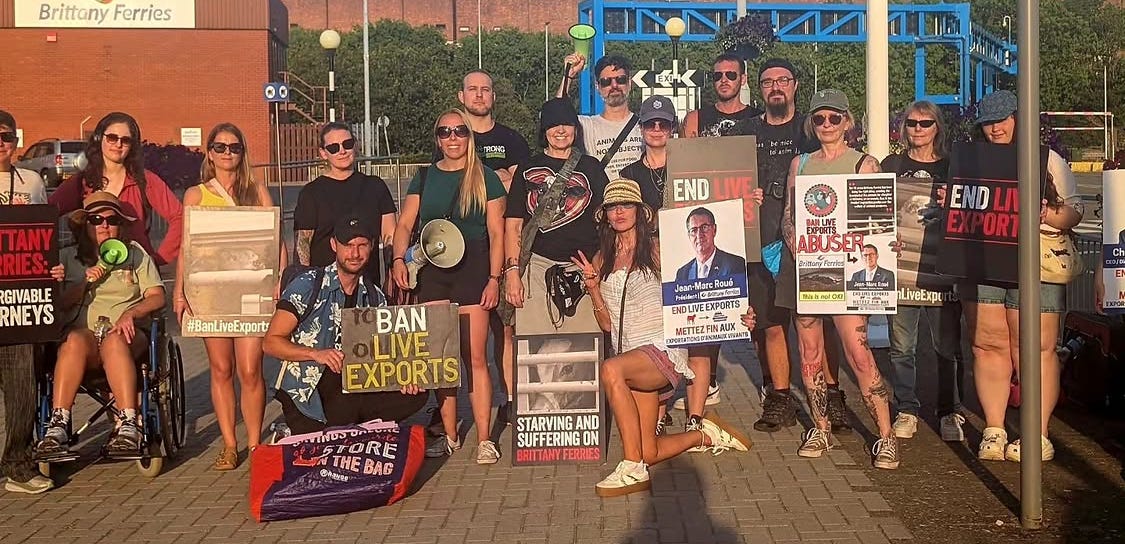
What our Brittany Ferries campaign success taught us about grassroots activism
Southampton Animal Action first began campaigning against Brittany Ferries’ decision to resume live exports in June 2025, protesting at their Portsmouth location with Compassion in World Farming. Just over one year later, on 3 August 2026, Southampton Animal Action received an email from Brittany Ferries’ CEO, Christophe Mathieu, confirming that he had decided to stop live exports for good, crediting our protests and disruptions. Over a year of campaigning resulted in a huge success!
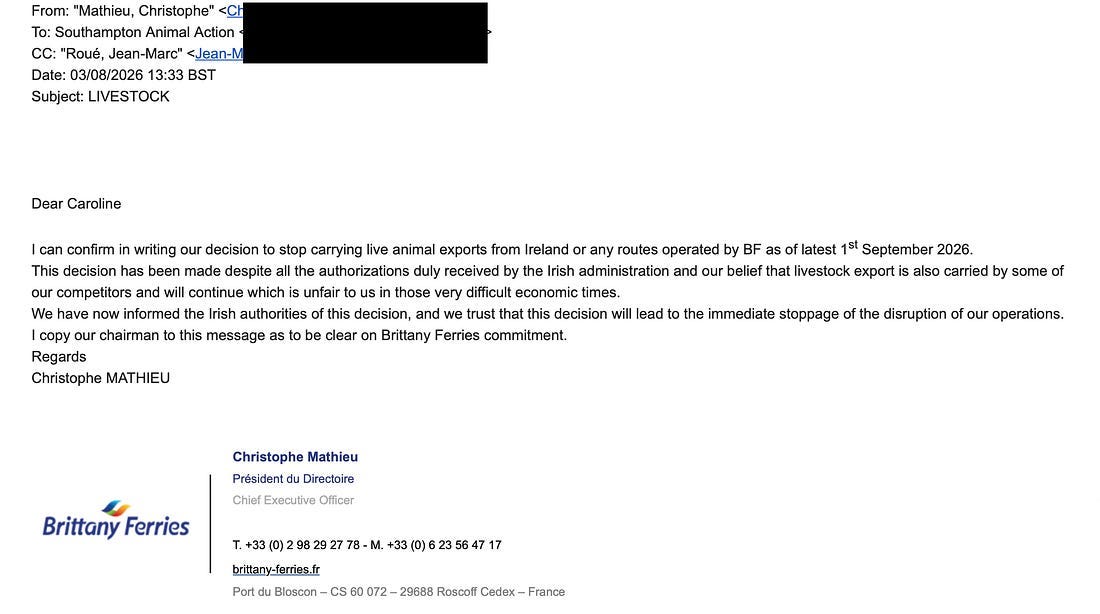
Southampton Animal Action is a local grassroots group who don’t have paid staff or a fundraising department. Most of the time, we have a small amount of money in our bank account to cover all campaigns, raised from quiz nights and other fundraisers organised by our volunteers. However, what we do have is a group of committed, persistent people, a willingness to be creative, and the belief that local groups should never underestimate what they can achieve.
Here is what we did and some of the lessons we learnt along the way.
Don’t wait for national organisations
One of the biggest lessons from this campaign is that grassroots groups don’t have to wait for national organisations to act. That doesn’t mean national organisations aren’t important. Compassion in World Farming organised the first protest in Portsmouth and had already been engaging with Brittany Ferries prior to us. However, we did not believe Brittany Ferries would change their decision with passive and infrequent campaigning. Grassroots groups can bring something different – we live locally, could organise regular protests at short notice, and could keep the issue visible week after week. We are a decentralised group who have the freedom to create our own rules, without waiting for approval.
National organisations and grassroots groups aren’t competitors – throughout the campaign we had a WhatsApp chat with Compassion in World Farming to keep in regular contact with one another, sharing updates, discussing ideas, and making sure our efforts complemented rather than duplicated one another. While Compassion in World Farming’s philosophy is different to ours, we made sure we came together to tackle a shared goal. So, the lesson isn’t to not work with larger organisations, but instead to make sure you aren’t waiting for them to take the lead.
Campaign and escalate creatively
Every protest doesn’t have to look the same, and as the campaign developed, we mixed things up. We protested outside Brittany Ferries’ Portsmouth office alongside Portsmouth International Port, timing the protests for when Brittany Ferries ships were arriving or leaving. We organised banner drops at the port, bought an inflatable cow costume to wear during protests, spoke to local media, created reels for Instagram, TikTok, Facebook and YouTube, searched for conferences and events Brittany Ferries would be attending, and even started planning protests in Roscoff, France (where Christophe Mathieu and other decision-makers are based). We collaborated with other local groups, including Dorset Animal Action, to protest Brittany Ferries’ Poole location, and with activists in London to campaign against their main UK shareholder, CMA CGM. Significantly, not being located near the decision-makers in Roscoff (or the route of the live exports themselves) didn’t stop us. While we often received comments saying we should be protesting in France, we believe the campaign worked because we caused disruption in multiple locations, rather than being restricted to one place.
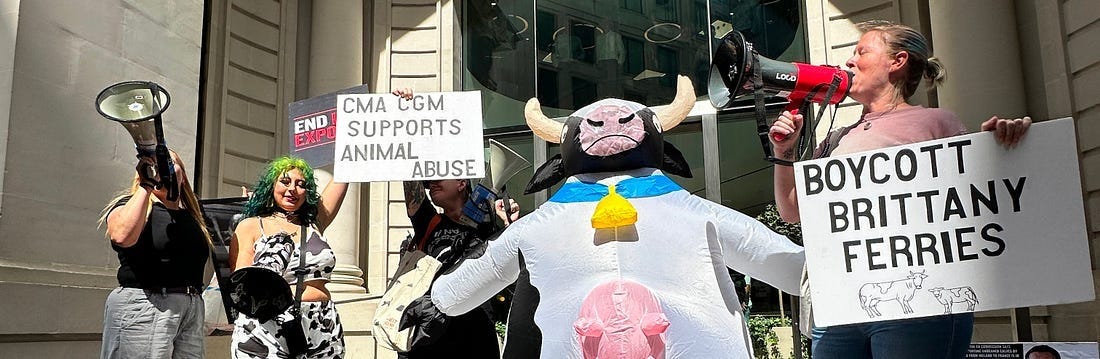
Some of our protests only involved two or three people, but we proceeded anyway and mixed up our tactics, because ultimately, we believe that consistency matters more than group size. In fact, anecdotally, some of the most impactful protests were with two of us, so we’d urge groups to not wait until you have “enough” people. We also made sure we had a role for everyone, and delegated tasks based on people’s strengths. I’m not a creative person, so others were in charge of creating placards and making social media reels! Some people simply wanted to turn up to a protest to hold a banner or hand out a leaflet, without talking to anyone. Others wanted a more behind-the-scenes role, such as writing a press release or putting up a poll to decide our next protest date. All roles are vital!
We also made sure we had conversations while protesting, for example with Brittany Ferries customers and port staff. Sometimes those conversations began with frustration or anger, so it was vital to de-escalate. One port worker shouted at us that our campaign wasn’t working and was also convinced that Southampton Animal Action was funded by large donors. When I explained that our campaign budget came largely from a gym-based fundraiser organised by volunteers (even letting him have a glance at our bank account) and explained the rationale behind our tactics, his demeanour softened. I don’t think I completely changed his mind that day, but he promised he would email Brittany Ferries to put pressure on them to stop. Sometimes success meant ending the conversation with mutual respect and encouraging people to take action, even if their only motivation was the chance that we might not come back! At every Southampton Animal Action meeting, we strategised and asked ourselves the same question: “What should the next step be?” We tried to be as imaginative as possible and kept things fun (more on that below!).
Make it fun
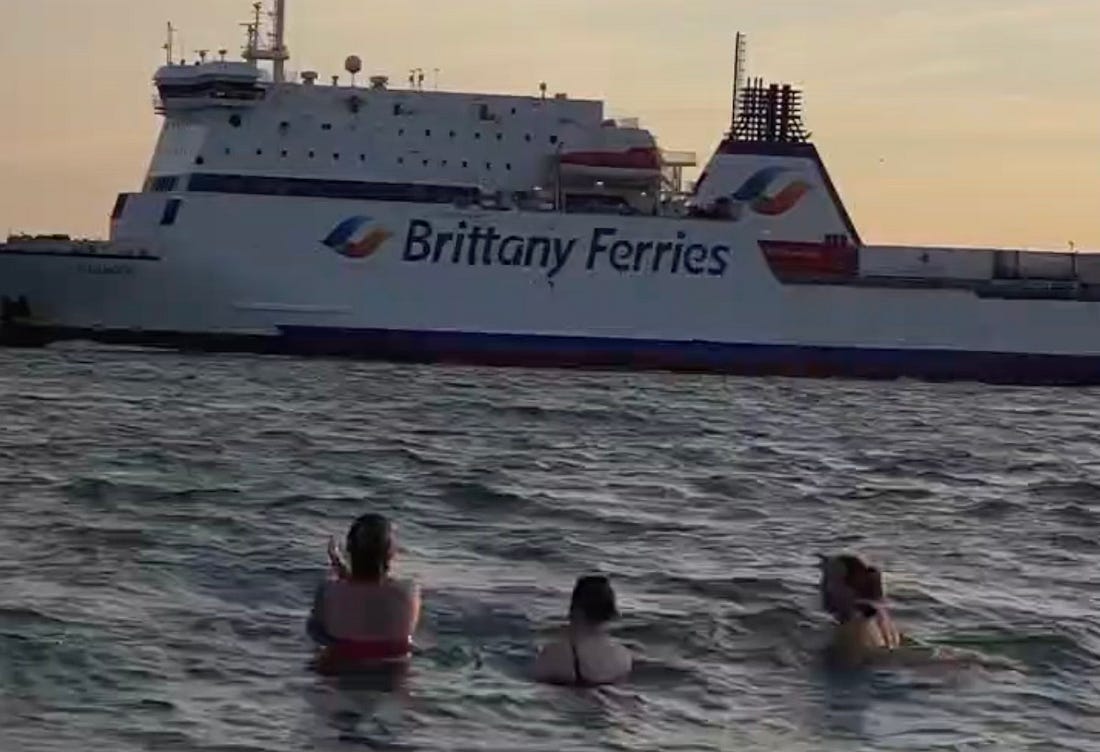
This might be the most important lesson of all, and something that kept campaigners coming back time and time again. Campaigning can be emotionally exhausting, and we often hear about activists feeling burnt out. From the start, we also didn’t know if it was even possible to win the campaign, and there was always a question in the back of many of our minds asking if we’d still be protesting this in 5 years’ time (or longer)! If you want activists to stay activists, it must include enjoyment. You can be campaigning against something serious and often horrific, but also have fun doing it. We laughed a lot, ‘occasionally’ fell over, and went for food together. On one memorable occasion we even found ourselves continuing an entirely unplanned protest from the sea after spotting a Brittany Ferries ship while swimming at Southsea beach. The friendships we built weren’t separate from the campaign – they were part of what sustained it.
Own your message
Historically, campaigns around live exports have often focused on animal welfare. As abolitionists, we wanted to make sure our campaign also spoke about animal use and exploitation more broadly. That meant, for example, creating our own leaflets instead of reproducing existing materials. Our leaflets explained the issue, encouraged people to contact Brittany Ferries directly, and included QR codes linking to vegan recipes and information about how veganism can reduce animal suffering. We made sure every interaction reflected our own values, and we weren’t afraid to communicate our own message.
Relatedly, there were moments during this campaign when compromise was discussed. One suggestion was that Brittany Ferries could stop transporting unweaned calves while continuing to transport older animals. We were clear that this wasn’t the change we were campaigning for and that we would continue protesting.
Grassroots groups shouldn’t be afraid of making ambitious demands that are ethically right. Sometimes people will tell you to moderate your message to appear ‘reasonable’, but our experience was that being clear about our principles helped people understand exactly what we stood for.
Build relationships
One of the biggest mistakes we made early in the campaign was assuming communication with Brittany Ferries was already happening through larger organisations, like Compassion in World Farming and Four Paws. Eventually, we decided to contact Brittany Ferries directly ourselves, with an email to Christophe Mathieu and other members of the executive leadership. After sending a follow-up email a couple of weeks later (including a read receipt which indicated he had opened it!), he emailed us back, sharing his number and inviting us for a WhatsApp call, leading to a conversation which went incredibly well. You don’t have to compromise your principles to have respectful conversations with decision-makers. Throughout the campaign we tried to remember that the goal was to change a decision, which meant remaining respectful towards individuals while never losing sight of the animals, who are the true victims of this trade. Building a rapport with Christophe kept a door open that might have been closed if the conversation was based on anger.
Ultimately, the WhatsApp calls and messages, we believe, were integral to the success of the campaign. Looking back, we wish we’d made contact much sooner.
Grassroots groups are more powerful than they think
Campaigns are won because ordinary people keep showing up. If you’re part of a local group wondering whether you can really influence a large international organisation, don’t underestimate what you’re capable of. You don’t need permission to start, a huge budget, or hundreds of people. Small groups have more power than they often realise because they can do things that larger organisations can’t. Consistent, creative and collaborative grassroots campaigning can be incredibly impactful. Happy activism!
Cat Phipps, Southampton Animal Action
If you want to join an existing AFN local group, you can find your nearest group here.
If you are already part of a local group that wants to join the Animal Freedom Network, you can reach out here.
Or if you want to start a local group and want support from the AFN, you can reach out here.
Lastly, if you want to help the Animal Freedom Network become an unstoppable mass movement for animal freedom in the UK, you can support any of the local groups directly through the links shared in this article, or you can support the wider Animal Freedom Network here. Any donations to the AFN will be put towards running bootcamps and trainings, producing resources and guides, and organising actions, events and protest convergences.